
【折纸转载】 Jayson Merrill F-16 战隼战斗机
Here is an English-language sports feature article about an F-16 fighter jet airshow performance, crafted in the style of a professional sports writer covering an aerial display as an elite sporting event.
Under a cloudless summer sky, the unmistakable silhouette of the F-16 Fighting Falcon ripped through the air, leaving a trail of thunder and awe. In the world of aerial performance, where pilots are the ultimate athletes and their aircraft become extensions of their own bodies, today’s F-16 solo display was nothing short of a championship-winning routine.
From the moment the Pratt & Whitney engine roared to life and the sleek, compact fighter taxied onto the runway, the crowd sensed they were about to witness something special. This wasn’t just a military demonstration; it was a high-octane sport of precision, endurance, and raw power — and the Viper was ready to play.

The takeoff was a statement of intent. Rather than a standard departure, the pilot pulled the jet into a near-vertical climb just meters above the tarmac, the afterburner punching a brilliant orange-and-blue diamond pattern into the sky. Within seconds, the F-16 was a dot, hurtling upward at a rate that would make any roller coaster feel tame. This was the opening move in a carefully choreographed dance that blends human physiology with 21st-century engineering.
What followed was a textbook display of the F-16’s famed maneuverability. The pilot guided the aircraft through a series of maximum-rate turns, the 9G forces pressing down on a body trained like that of an Olympic weightlifter. Every muscle contraction, every controlled breath, is a countermeasure against the blood-draining, vision-narrowing reality of high-G flight. Spectators watched the vapor shimmering over the wings as the jet carved arcs so tight they seemed to defy physics.

The highlight reel included the jaw-dropping “cobra-like” high-alpha pass, where the F-16 seemed to hang motionless in the air for a heartbeat before its engine thrust overpowered gravity and it muscled forward. There was the slow, dirty pass — landing gear down, speed brakes deployed — that demonstrated the fighter’s low-speed control, followed by a lightning-fast afterburner sprint that punctuated the silence with a chest-thumping crack.
The signature move of the routine, however, was the minimum radius turn. With a deft touch on the side-stick controller, the pilot stood the Viper on its wingtip and pivoted as if bolted to a pole, completing a 360-degree circuit in a space that would shame a sports car. It’s here that the F-16’s fly-by-wire system truly shines, translating the pilot’s split-second decisions into seamless, fluid poetry. From the ground, the jet looked less like a machine and more like a living creature staking its claim to the sky.
As the performance reached its crescendo, the pilot put the Falcon through a series of consecutive aileron rolls and a dramatic inverted pass, the cockpit canopy facing the ground, the pilot seemingly defying both gravity and common sense. The finale — a high-speed spiral climb into a vertical break — scattered sound waves across the airfield like a drumroll before the fighter dipped its wings in salute and glided back for a featherlight landing.
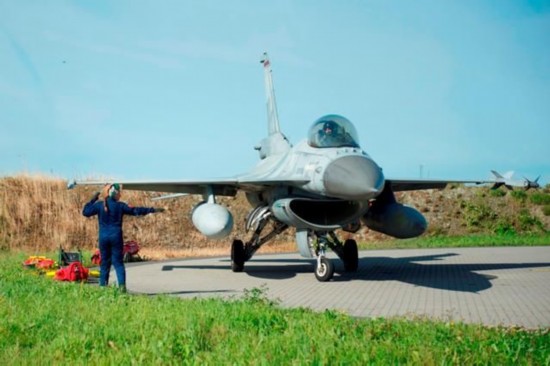
In the pantheon of airshow performers, the F-16 Fighting Falcon remains a true athlete. It demands everything from the person in the cockpit: cardiovascular stamina, spatial awareness, and mental fortitude. Every display is a live-action reminder that the boundary between sport and flight is not just blurred — it’s shattered at Mach 0.9.
When the canopy opened and the pilot climbed down, drenched in sweat and grinning, you didn’t need a scorecard to know what everyone in attendance already understood: the F-16 had just delivered a gold-medal performance. And in this sport, the sky is never the limit — it’s the playing field.